MX Calibrate#
Calibrate a translation table from a set of powder diffraction images taken at various sample-detector distances.
This is a notebook replacement of the MX-calibrate tool from pyFAI with advanced features.
Start with some constant definition:#
calibrant_name = "CeO2"
detector_name = "Pilatus 2M"
file_pattern = "massif1/test-powder*.cbf"
result_file = "MX-calibrate.json"
wavelength = None # set a value to override the one in the headers
!wget http://www.silx.org/pub/pyFAI/massif1.tar.bz2
!tar -xvjf massif1.tar.bz2
--2026-09-15 10:01:51--  http://www.silx.org/pub/pyFAI/massif1.tar.bz2
Resolving www.silx.org (www.silx.org)... 195.154.237.27
Connecting to www.silx.org (www.silx.org)|195.154.237.27|:80... connected.
HTTP request sent, awaiting response... 200 OK
Length: 6784503 (6.5M) [application/x-bzip2]
Saving to: ‘massif1.tar.bz2.17’

massif1.tar.bz2.17  100%[===================>]   6.47M  --.-KB/s    in 0.1s

2026-09-15 10:01:52 (63.8 MB/s) - ‘massif1.tar.bz2.17’ saved [6784503/6784503]

massif1/
massif1/test-powder_5_0001.poni
massif1/test-powder_4_0001.cbf
massif1/test-powder_6_0001.poni
massif1/test-powder_8_0001.cbf
massif1/test-powder_7_0001.cbf
massif1/test-powder_7_0001.poni
massif1/test-powder_3_0001.cbf
massif1/test-powder_1_0001.poni
massif1/test-powder_4_0001.poni
massif1/test-powder_8_0001.poni
massif1/test-powder_2_0001.poni
massif1/test-powder_6_0001.cbf
massif1/test-powder_2_0001.cbf
massif1/test-powder_5_0001.cbf
massif1/test-powder_3_0001.poni
massif1/test-powder_1_0001.cbf
%matplotlib widget
#inline2
import os
import glob
import logging
import numpy
from matplotlib.pyplot import subplots
from scipy.stats import linregress
import fabio
import pyFAI
from pyFAI.gui import jupyter
import pyFAI.calibrant
from pyFAI.gui.jupyter.calib import Calibration
from pyFAI.goniometer import GeometryTransformation, GoniometerRefinement
from pyFAI.gui.cli_calibration import AbstractCalibration
import pyFAI.gui.mpl_calib
pyFAI.gui.mpl_calib.logger.setLevel(logging.ERROR)
pyFAI.gui.peak_picker.logger.setLevel(logging.CRITICAL)
print(f"Running pyFAI version {pyFAI.version}")
WARNING:pyFAI.gui.matplotlib:Matplotlib already loaded with backend `widget`, setting its backend to `QtAgg` may not work!
Running pyFAI version 2026.9.0
detector = pyFAI.detector_factory(detector_name)
calibrant = pyFAI.calibrant.get_calibrant(calibrant_name)
files = sorted(glob.glob(file_pattern))
print("input files: "+" ".join(files))
input files: massif1/test-powder_1_0001.cbf massif1/test-powder_2_0001.cbf massif1/test-powder_3_0001.cbf massif1/test-powder_4_0001.cbf massif1/test-powder_5_0001.cbf massif1/test-powder_6_0001.cbf massif1/test-powder_7_0001.cbf massif1/test-powder_8_0001.cbf
first = fabio.open(files[0])

def get_dectris_headers(fimg):
    """return the dectris headers from a Pilatus detector"""
    res = {}
    for line in fimg.header.get("_array_data.header_contents", "").split("\n"):
        words = line.split()
        if len(words)>=3:
            key = words[1]
            for v in words[2:]:
                try:
                    vf = float(v)
                except:
                    continue
                if not("." in v or "e" in v):
                    vf = int(v)
                res[key] = vf
    return res

get_dectris_headers(first)
{'Silicon': 0.00045,
 'Pixel_size': 0.000172,
 'N_oscillations': 1,
 'Chi': 0.0,
 'Phi': 0.0,
 'Kappa': 0.0,
 'Alpha': 0.0,
 'Polarization': 0.99,
 'Detector_2theta': 0.0,
 'Angle_increment': 1.0,
 'Transmission': 100.0,
 'Flux': 436215830143.2828,
 'Detector_Voffset': 0.0,
 'Detector_distance': 0.126474,
 'Wavelength': 0.965459,
 'N_excluded_pixels:': 321,
 'Threshold_setting': 6421,
 'Count_cutoff': 1048500,
 'Tau': 0,
 'Exposure_period': 0.02115,
 'Exposure_time': 0.02,
 'Start_angle': 0.0}
if wavelength is None:
    wavelength = get_dectris_headers(first)["Wavelength"] * 1e-10
calibrant.wavelength = wavelength
#apply mask to the detector
mask = numpy.logical_or(detector.mask, first.data<0)
detector.mask = mask
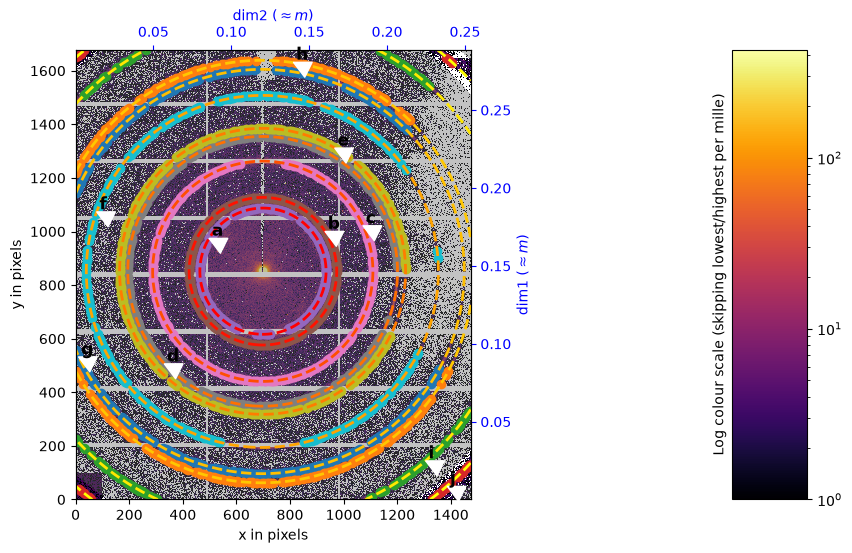
Manual calibration of the first image#
# Important: select the ring number before right-click on the ring. Finally click on the refine button
calib = Calibration(img=first.data,
                    mask=mask,
                    detector=detector,
                    wavelength=wavelength,
                    calibrant=calibrant)
_ = input("Break automatic execution ... press enter after picking at least 2 rings!")
calib.extract_cpt()
# calib.geoRef.rot1 = calib.geoRef.rot2 = calib.geoRef.rot3 = 0
calib.refine(fixed=["wavelength", "rot3"])
Before refinement, the geometry is:
Detector Pilatus 2M	 PixelSize= 172µm, 172µm	 BottomRight (3)
Wavelength= 0.965459 Å
SampleDetDist= 1.262456e-01 m	PONI= 1.469821e-01, 1.209311e-01 m	rot1=0.004286  rot2=-0.002536  rot3=0.000000 rad
DirectBeamDist= 126.247 mm	Center: x=699.942, y=852.685 pix	Tilt= 0.285° tiltPlanRotation= -149.386° λ= 0.965Å
Detector Pilatus 2M	 PixelSize= 172µm, 172µm	 BottomRight (3)
Wavelength= 0.965459 Å
SampleDetDist= 1.263249e-01 m	PONI= 1.468557e-01, 1.209535e-01 m	rot1=0.004484  rot2=-0.001736  rot3=0.000000 rad
DirectBeamDist= 126.326 mm	Center: x=699.925, y=852.537 pix	Tilt= 0.275° tiltPlanRotation= -158.834° λ= 0.965Å
Detector Pilatus 2M	 PixelSize= 172µm, 172µm	 BottomRight (3)
Wavelength= 0.965459 Å
SampleDetDist= 1.263249e-01 m	PONI= 1.468557e-01, 1.209535e-01 m	rot1=0.004484  rot2=-0.001736  rot3=0.000000 rad
DirectBeamDist= 126.326 mm	Center: x=699.925, y=852.537 pix	Tilt= 0.275° tiltPlanRotation= -158.834° λ= 0.965Å
Detector Pilatus 2M	 PixelSize= 172µm, 172µm	 BottomRight (3)
Wavelength= 0.965459 Å
SampleDetDist= 1.263249e-01 m	PONI= 1.468557e-01, 1.209535e-01 m	rot1=0.004484  rot2=-0.001736  rot3=0.000000 rad
DirectBeamDist= 126.326 mm	Center: x=699.925, y=852.537 pix	Tilt= 0.275° tiltPlanRotation= -158.834° λ= 0.965Å
#Return to `inline` mode
%matplotlib inline
calib.peakPicker.widget.fig.show()
Check that the beam-center and the distance is correct and how much they are off.
Calibration of all frames in automatic mode:#
# Definition of the geometry translation function:
def get_distance(fimg):
    return get_dectris_headers(fimg)["Detector_distance"]

geotrans = GeometryTransformation(param_names = ["dist_offset",
                                                 "poni1", "poni2", "rot1","rot2",
                                                "dist_scale", "poni1_scale", "poni2_scale"],
                                  dist_expr="pos * dist_scale + dist_offset",
                                  poni1_expr="pos * poni1_scale + poni1",
                                  poni2_expr="pos * poni2_scale + poni2",
                                  rot1_expr="rot1",
                                  rot2_expr="rot2",
                                  rot3_expr="0.0")

param = {
         "dist_offset": calib.geoRef.dist-get_distance(first),
         "poni1": calib.geoRef.poni1,
         "poni2": calib.geoRef.poni2,
         "rot1": calib.geoRef.rot1,
         "rot2": calib.geoRef.rot2,
         "dist_scale": 1.0,
         "poni1_scale": 0.0,
         "poni2_scale": 0.0,
}

print(param)
{'dist_offset': np.float64(-0.00014913206020975012), 'poni1': np.float64(0.14685571451823223), 'poni2': np.float64(0.12095346033825614), 'rot1': np.float64(0.004483627708011328), 'rot2': np.float64(-0.0017360133863229268), 'dist_scale': 1.0, 'poni1_scale': 0.0, 'poni2_scale': 0.0}
# Definition of the geometry refinement: the parameter order is the same as the param_names

gonioref = GoniometerRefinement(param, #initial guess
                                pos_function=get_distance,
                                trans_function=geotrans,
                                detector=detector,
                                wavelength=wavelength)
print("Empty refinement object:")
print(gonioref)
Empty refinement object:
GoniometerRefinement with 0 geometries labeled: .
# Let's populate the goniometer refinement object with all geometries:

for fn in files:
    base = os.path.splitext(fn)[0]

    fimg = fabio.open(fn)
    local_calib = AbstractCalibration(img=fimg.data, mask=mask,
                                      detector=detector,
                                      wavelength=wavelength,
                                      calibrant=calibrant)
    local_calib.preprocess()
    local_calib.fixed = ["wavelength", "rot3"]
    local_calib.ai = gonioref.get_ai(get_distance(fimg))
    local_calib.extract_cpt()
    sg = gonioref.new_geometry(os.path.basename(base), image=fimg.data, metadata=fimg,
                              control_points=local_calib.peakPicker.points,
                              geometry=local_calib.ai,
                              calibrant=calibrant)

print("Filled refinement object:")
print(gonioref)
print(os.linesep+"\tLabel \t Distance")
for k, v in gonioref.single_geometries.items():
    print(k,v.get_position())
Filled refinement object:
GoniometerRefinement with 8 geometries labeled: test-powder_1_0001, test-powder_2_0001, test-powder_3_0001, test-powder_4_0001, test-powder_5_0001, test-powder_6_0001, test-powder_7_0001, test-powder_8_0001.

	Label 	 Distance
test-powder_1_0001 0.126474
test-powder_2_0001 0.141749
test-powder_3_0001 0.199249
test-powder_4_0001 0.171074
test-powder_5_0001 0.226674
test-powder_6_0001 0.293162
test-powder_7_0001 0.357899
test-powder_8_0001 0.484611
fig, ax = subplots(len(files), figsize=(10, 10*len(files)))
for sp, sg in zip(ax, gonioref.single_geometries.values()):
    jupyter.display(sg=sg, ax=sp, label=sg.label)

gonioref.refine3(fix=["dist_scale", "poni1_scale", "poni2_scale"])
Free parameters: ['dist_offset', 'poni1', 'poni2', 'rot1', 'rot2']
Fixed: {'dist_scale': 1.0, 'poni1_scale': 0.0, 'poni2_scale': 0.0}
     message: Optimization terminated successfully
     success: True
      status: 0
         fun: 2.3161552730611774e-07
           x: [-8.794e-05  1.468e-01  1.208e-01  3.383e-03 -1.306e-03]
         nit: 13
         jac: [-9.697e-07  1.194e-07  4.072e-07 -1.710e-07 -2.315e-09]
        nfev: 82
        njev: 13
 multipliers: []
Constrained Least square 3.6671009975018576e-07 --> 2.3161552730611774e-07
maxdelta on rot1: 0.004483627708011328 --> 0.0033832488199193656
np.float64(2.3161552730611774e-07)
gonioref.refine3(fix=[])
Free parameters: ['dist_offset', 'poni1', 'poni2', 'rot1', 'rot2', 'dist_scale', 'poni1_scale', 'poni2_scale']
Fixed: {}
     message: Optimization terminated successfully
     success: True
      status: 0
         fun: 1.6487233849615964e-07
           x: [-3.395e-04  1.468e-01  1.207e-01  4.891e-03 -1.581e-03
                1.002e+00  4.850e-04  2.327e-03]
         nit: 16
         jac: [ 3.318e-10 -8.962e-09  1.192e-09 -1.972e-08 -1.003e-07
               -6.348e-09  1.899e-07 -3.419e-08]
        nfev: 147
        njev: 16
 multipliers: []
Constrained Least square 2.3161552730611774e-07 --> 1.6487233849615964e-07
maxdelta on poni2_scale: 0.0 --> 0.002327167027287695
np.float64(1.6487233849615964e-07)
Interpretation of this fit:
gonioref.get_ai(0.2)
Detector Pilatus 2M	 PixelSize= 172µm, 172µm	 BottomRight (3)
Wavelength= 0.965459 Å
SampleDetDist= 1.999861e-01 m	PONI= 1.468659e-01, 1.212049e-01 m	rot1=0.004891  rot2=-0.001581  rot3=0.000000 rad
DirectBeamDist= 199.989 mm	Center: x=698.993, y=852.033 pix	Tilt= 0.294° tiltPlanRotation= -162.087° λ= 0.965Å
gonioref.get_ai(0.3)
Detector Pilatus 2M	 PixelSize= 172µm, 172µm	 BottomRight (3)
Wavelength= 0.965459 Å
SampleDetDist= 3.001489e-01 m	PONI= 1.469144e-01, 1.214376e-01 m	rot1=0.004891  rot2=-0.001581  rot3=0.000000 rad
DirectBeamDist= 300.153 mm	Center: x=697.498, y=851.394 pix	Tilt= 0.294° tiltPlanRotation= -162.087° λ= 0.965Å
Persistence of this fit
gonioref.save(result_file)
with open(result_file) as r:
    print(r.read())
{
  "content": "Goniometer calibration v2",
  "detector": "Pilatus 2M",
  "detector_config": {
    "pixel1": 0.000172,
    "pixel2": 0.000172,
    "orientation": 3
  },
  "wavelength": 9.65459e-11,
  "param": [
    -0.00033954981977020265,
    0.1467688513241301,
    0.12073943359370902,
    0.00489072600994118,
    -0.0015809165618941988,
    1.001628283788581,
    0.0004850259006493135,
    0.002327167027287695
  ],
  "param_names": [
    "dist_offset",
    "poni1",
    "poni2",
    "rot1",
    "rot2",
    "dist_scale",
    "poni1_scale",
    "poni2_scale"
  ],
  "pos_names": [
    "pos"
  ],
  "trans_function": {
    "content": "GeometryTransformation",
    "param_names": [
      "dist_offset",
      "poni1",
      "poni2",
      "rot1",
      "rot2",
      "dist_scale",
      "poni1_scale",
      "poni2_scale"
    ],
    "pos_names": [
      "pos"
    ],
    "dist_expr": "pos * dist_scale + dist_offset",
    "poni1_expr": "pos * poni1_scale + poni1",
    "poni2_expr": "pos * poni2_scale + poni2",
    "rot1_expr": "rot1",
    "rot2_expr": "rot2",
    "rot3_expr": "0.0",
    "constants": {
      "pi": 3.141592653589793
    }
  }
}
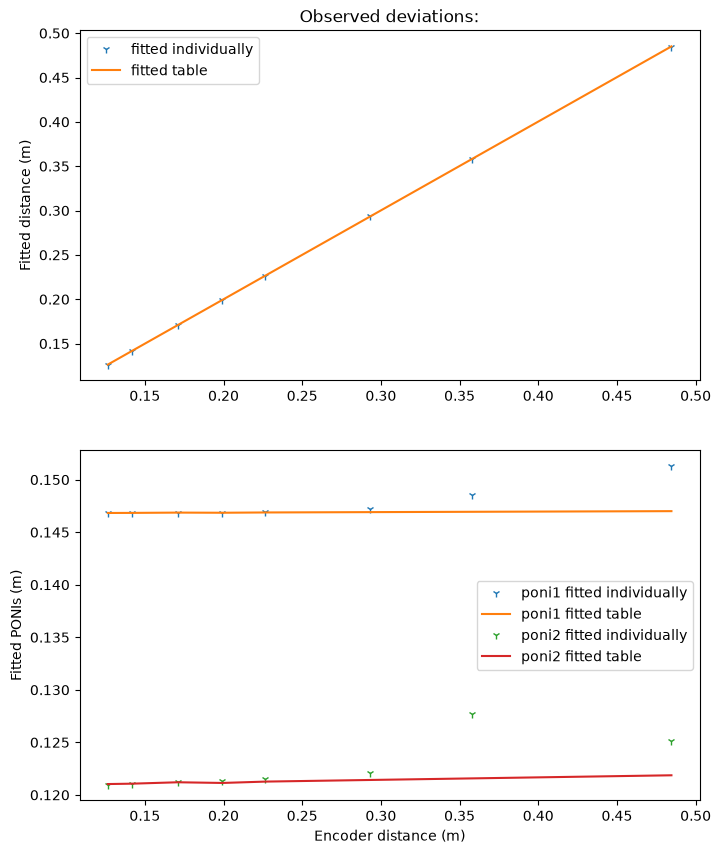
Interpretation of the fit:
distances = []
f_distances = []
f_poni1 = []
f_poni2 = []
g_distances = []
g_poni1 = []
g_poni2 = []
for sg in gonioref.single_geometries.values():
    distance = sg.get_position()
    distances.append(distance)
    sg.geometry_refinement.refine3(fix=["wavelength", "rot3"])
    f_distances.append(sg.geometry_refinement.dist)
    f_poni1.append(sg.geometry_refinement.poni1)
    f_poni2.append(sg.geometry_refinement.poni2)
    ai = gonioref.get_ai(distance)
    g_distances.append(ai.dist)
    g_poni1.append(ai.poni1)
    g_poni2.append(ai.poni2)

order = numpy.argsort(distances)
distances = numpy.take(distances, order)
f_distances = numpy.take(f_distances, order)
f_poni1 = numpy.take(f_poni1, order)
f_poni2 = numpy.take(f_poni2, order)
g_distances = numpy.take(g_distances, order)
g_poni1 = numpy.take(g_poni1, order)
g_poni1 = numpy.take(g_poni1, order)
fig,ax = subplots(2, figsize=(8,10))
ax[0].plot(distances, f_distances, "1", label="fitted individually")
ax[0].plot(distances, g_distances, label="fitted table")
ax[0].set_title("Observed deviations:")
ax[1].set_xlabel("Encoder distance (m)")
ax[1].plot(distances, f_poni1, "1", label="poni1 fitted individually")
ax[1].plot(distances, g_poni1, label="poni1 fitted table")
ax[1].plot(distances, f_poni2, "1", label="poni2 fitted individually")
ax[1].plot(distances, g_poni2, label="poni2 fitted table")
ax[0].set_ylabel("Fitted distance (m)")
ax[1].set_ylabel("Fitted PONIs (m)")
ax[0].legend()
ax[1].legend();
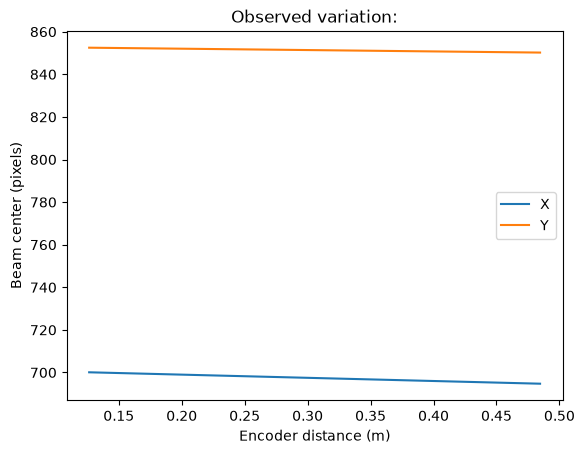
obtained_x = []
obtained_y = []

for dst in distances:
    geo = gonioref.get_ai(dst)
    fit2d = geo.getFit2D()
    obtained_x.append(fit2d["centerX"])
    obtained_y.append(fit2d["centerY"])
fig,ax = subplots()
ax.plot(distances, obtained_x, label="X")
ax.plot(distances, obtained_y, label="Y")
ax.set_title("Observed variation:")
ax.set_ylabel("Beam center (pixels)")
ax.set_xlabel("Encoder distance (m)")
ax.legend();
#Simply print out the result:
lrx = linregress(distances, obtained_x)
lry = linregress(distances, obtained_y)
print(f"Beam-center X: {lrx}")
print(f"Beam-center y: {lry}")
print()
print(f"beamcenter_x = {lrx.intercept:.3f} {lrx.slope:+.3f} * encoder_value")
print(f"beamcenter_y = {lry.intercept:.3f} {lry.slope:+.3f} * encoder_value")
Beam-center X: LinregressResult(slope=np.float64(-14.950939130715136), intercept=np.float64(701.9831061167721), rvalue=np.float64(-1.0), pvalue=np.float64(2.4999999999999984e-60), stderr=np.float64(0.0), intercept_stderr=np.float64(0.0))
Beam-center y: LinregressResult(slope=np.float64(-6.386541275470018), intercept=np.float64(853.3103961100635), rvalue=np.float64(-1.0), pvalue=np.float64(2.4999999999999984e-60), stderr=np.float64(0.0), intercept_stderr=np.float64(0.0))

beamcenter_x = 701.983 -14.951 * encoder_value
beamcenter_y = 853.310 -6.387 * encoder_value
Nota:
The degradation between 0.3 and 0.5m correspond to the image 6->7 and is related to the disappearance of the third ring!
Conclusion:#
This notebook demonstrates:
The usage of the geometry calibration in JupyterLab to calibrate the first image
The creation of a goniometer-refinement
The population of this goniometer-refinement with automatic control-point extraction
The fit of the table, first with the constraints of a perfectly aligned table, then with a misaligned table
In our case the table is misaligned in the horizontal direction by 2.3mm/meter (i.e. 2.3 mradian). This should be taken into account when calculating the beam-center at different distances.