Filtering signal in azimuthal space#
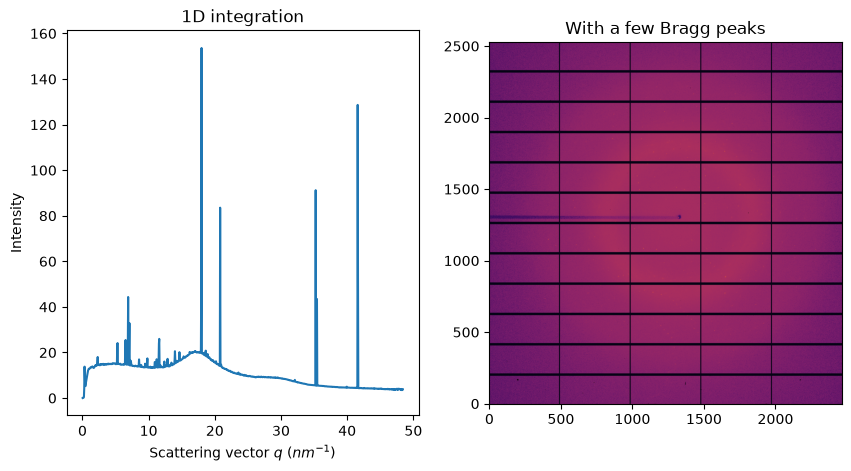
Usually, diffraction signal presents a polar symmetry, this means all pixels with the same azimuthal angle (χ) have similar intensities. The best way to exploit this is to take the mean, what is called azimuthal average. But the average is very sensitive to outliers, like gaps, missing pixels, shadows, cosmic rays or reflections coming from larger crystallites. In this tutorial we will see two alternative ways to remove those unwanted signals and focus on the majority of pixels: sigma clipping and median filtering.
import os
os.environ["PYOPENCL_COMPILER_OUTPUT"]="0"
import pyFAI
print(f"pyFAI version: {pyFAI.version}")
pyFAI version: 2026.9.0
%matplotlib inline
from matplotlib.pyplot import subplots
from pyFAI.gui import jupyter
import numpy
import fabio
from pyFAI.test.utilstest import UtilsTest
import pyFAI.benchmark

figsize = (10,5)

ai = pyFAI.load(UtilsTest.getimage("Pilatus6M.poni"))
img = fabio.open(UtilsTest.getimage("Pilatus6M.cbf")).data
fig, ax = subplots(1, 2, figsize=figsize)
jupyter.display(img, ax=ax[1])
jupyter.plot1d(ai.integrate1d(img, 1000), ax=ax[0])
ax[1].set_title("With a few Bragg peaks");
WARNING:pyFAI.gui.matplotlib:Matplotlib already loaded with backend `inline`, setting its backend to `QtAgg` may not work!
Azimuthal sigma-clipping#
The idea is to discard pixels which look like outliers in the distribution of all pixels contributing to a single azimuthal bin. It requires an error model like poisson but it has been proven to be better to use the variance in the given azimuthal ring. All details are available in this publication: https://doi.org/10.1107/S1600576724011038 also available at https://doi.org/10.48550/arXiv.2411.09515
fig, ax = subplots(1, 2, figsize=figsize)
jupyter.display(img, ax=ax[1])
jupyter.plot1d(ai.sigma_clip(img, 1000, error_model="hybrid", method=("no", "csr", "cython")), ax=ax[0])
ax[1].set_title("With a few Bragg peaks")
ax[0].set_title("Sigma_clipping");
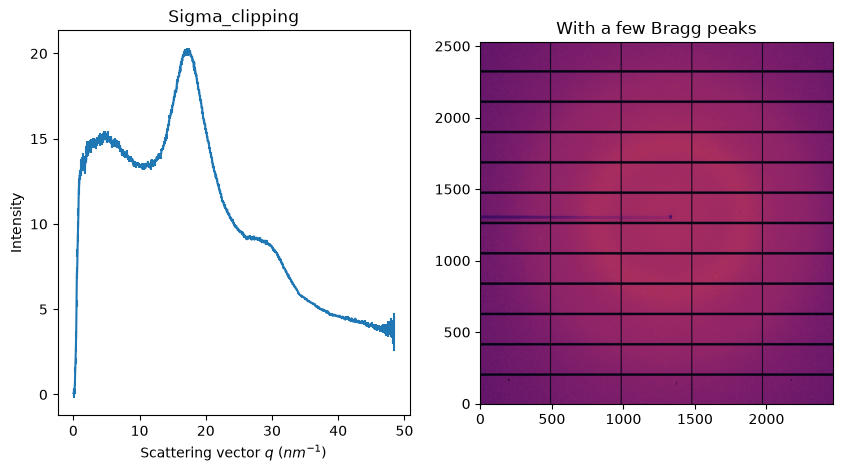
Of course, sigma-clip takes several extra parameters like the number of iterations to perform, the cut-off, the error model, … There are also a few limitations:
The algorithm needs to be the CSR-sparse matrix multiplication: since several integrations are needed, it makes no sense to use a histogram based algorithm.
The algorithm is available with any implementation: Python (using scipy.saprse), Cython and OpenCL, and it runs just fine on GPU.
Sigma-clipping is incompatible with any kind of pixel splitting: With pixel splitting, a single pixel can contribute to several azimuthal bins and discarding a pixel in one ring could disable it in the neighboring ring (or not, since bins are processed in parallel).
Sigma-clipping performances:#
method = ["no", "csr", "cython"]
%%time
perfs_integrate_python = {}
perfs_integrate_cython = {}
perfs_integrate_opencl = {}
perfs_sigma_clip_python = {}
perfs_sigma_clip_cython = {}
perfs_sigma_clip_opencl = {}

for ds in pyFAI.benchmark.PONIS:
    ai = pyFAI.load(UtilsTest.getimage(ds))
    if ai.wavelength is None: ai.wavelength=1.54e-10
    img = fabio.open(UtilsTest.getimage(pyFAI.benchmark.datasets[ds])).data
    size = numpy.prod(ai.detector.shape)
    print(ds)
    print("     Cython")
    meth = tuple(method)
    nbin = max(ai.detector.shape)
    print("     * integrate ", end="")
    perfs_integrate_cython[size] = %timeit -o ai.integrate1d(img, nbin, method=meth)
    print("     * sigma-clip", end="")
    perfs_sigma_clip_cython[size] = %timeit -o ai.sigma_clip(img, nbin, method=meth, error_model="azimuthal")
    print("     Python")
    meth = tuple(method[:2]+["python"])
    print("     * integrate ", end="")
    perfs_integrate_python[size] = %timeit -o ai.integrate1d(img, nbin, method=meth)
    print("     * sigma-clip", end="")
    perfs_sigma_clip_python[size] = %timeit -o ai.sigma_clip(img, nbin, method=meth, error_model="azimuthal")

    print("     OpenCL")
    meth = tuple(method[:2]+["opencl"])
    print("     * integrate ", end="")
    perfs_integrate_opencl[size] = %timeit -o ai.integrate1d(img, nbin, method=meth)
    print("     * sigma-clip", end="")
    perfs_sigma_clip_opencl[size] = %timeit -o ai.sigma_clip(img, nbin, method=meth, error_model="azimuthal")
Pilatus1M.poni
     Cython
     * integrate
14.5 ms ± 1.04 ms per loop (mean ± std. dev. of 7 runs, 100 loops each)
     * sigma-clip
13.4 ms ± 1.2 ms per loop (mean ± std. dev. of 7 runs, 100 loops each)
     Python
     * integrate
10.1 ms ± 126 μs per loop (mean ± std. dev. of 7 runs, 100 loops each)
     * sigma-clip
163 ms ± 2.05 ms per loop (mean ± std. dev. of 7 runs, 10 loops each)
     OpenCL
     * integrate
685 μs ± 1.87 μs per loop (mean ± std. dev. of 7 runs, 1,000 loops each)
     * sigma-clip
2.43 ms ± 9.09 μs per loop (mean ± std. dev. of 7 runs, 100 loops each)
Pilatus2M.poni
     Cython
     * integrate
22.8 ms ± 2.77 ms per loop (mean ± std. dev. of 7 runs, 1 loop each)
     * sigma-clip
22.3 ms ± 2.08 ms per loop (mean ± std. dev. of 7 runs, 10 loops each)
     Python
     * integrate
33.7 ms ± 59.1 μs per loop (mean ± std. dev. of 7 runs, 10 loops each)
     * sigma-clip
553 ms ± 1.28 ms per loop (mean ± std. dev. of 7 runs, 1 loop each)
     OpenCL
     * integrate
1.11 ms ± 1.49 μs per loop (mean ± std. dev. of 7 runs, 1,000 loops each)
     * sigma-clip
6.06 ms ± 35.6 μs per loop (mean ± std. dev. of 7 runs, 100 loops each)
Eiger4M.poni
     Cython
     * integrate
33.6 ms ± 2.79 ms per loop (mean ± std. dev. of 7 runs, 1 loop each)
     * sigma-clip
31.9 ms ± 872 μs per loop (mean ± std. dev. of 7 runs, 10 loops each)
     Python
     * integrate
60.5 ms ± 199 μs per loop (mean ± std. dev. of 7 runs, 10 loops each)
     * sigma-clip
1.13 s ± 2.41 ms per loop (mean ± std. dev. of 7 runs, 1 loop each)
     OpenCL
     * integrate
2.16 ms ± 16.8 μs per loop (mean ± std. dev. of 7 runs, 100 loops each)
     * sigma-clip
10.8 ms ± 31.6 μs per loop (mean ± std. dev. of 7 runs, 100 loops each)
Pilatus6M.poni
     Cython
     * integrate
43 ms ± 3.01 ms per loop (mean ± std. dev. of 7 runs, 1 loop each)
     * sigma-clip
37.6 ms ± 1.9 ms per loop (mean ± std. dev. of 7 runs, 10 loops each)
     Python
     * integrate
82.3 ms ± 541 μs per loop (mean ± std. dev. of 7 runs, 10 loops each)
     * sigma-clip
1.56 s ± 1.85 ms per loop (mean ± std. dev. of 7 runs, 1 loop each)
     OpenCL
     * integrate
3.02 ms ± 2.87 μs per loop (mean ± std. dev. of 7 runs, 100 loops each)
     * sigma-clip
14.1 ms ± 46.3 μs per loop (mean ± std. dev. of 7 runs, 100 loops each)
Eiger9M.poni
     Cython
     * integrate
67.5 ms ± 2.89 ms per loop (mean ± std. dev. of 7 runs, 1 loop each)
     * sigma-clip
65.6 ms ± 1.05 ms per loop (mean ± std. dev. of 7 runs, 10 loops each)
     Python
     * integrate
150 ms ± 521 μs per loop (mean ± std. dev. of 7 runs, 10 loops each)
     * sigma-clip
3.15 s ± 4.22 ms per loop (mean ± std. dev. of 7 runs, 1 loop each)
     OpenCL
     * integrate
4.57 ms ± 12.9 μs per loop (mean ± std. dev. of 7 runs, 100 loops each)
     * sigma-clip
25.7 ms ± 17.8 μs per loop (mean ± std. dev. of 7 runs, 10 loops each)
Mar3450.poni
     Cython
     * integrate
66.1 ms ± 3.61 ms per loop (mean ± std. dev. of 7 runs, 1 loop each)
     * sigma-clip
69.1 ms ± 2.85 ms per loop (mean ± std. dev. of 7 runs, 10 loops each)
     Python
     * integrate
162 ms ± 290 μs per loop (mean ± std. dev. of 7 runs, 10 loops each)
     * sigma-clip
3.51 s ± 17.2 ms per loop (mean ± std. dev. of 7 runs, 1 loop each)
     OpenCL
     * integrate
5.24 ms ± 5.6 μs per loop (mean ± std. dev. of 7 runs, 100 loops each)
     * sigma-clip
28.9 ms ± 29.4 μs per loop (mean ± std. dev. of 7 runs, 10 loops each)
Fairchild.poni
     Cython
     * integrate
105 ms ± 2.48 ms per loop (mean ± std. dev. of 7 runs, 1 loop each)
     * sigma-clip
122 ms ± 2.18 ms per loop (mean ± std. dev. of 7 runs, 10 loops each)
     Python
     * integrate
378 ms ± 1.55 ms per loop (mean ± std. dev. of 7 runs, 1 loop each)
     * sigma-clip
9.63 s ± 24.8 ms per loop (mean ± std. dev. of 7 runs, 1 loop each)
     OpenCL
     * integrate
4.91 ms ± 40 μs per loop (mean ± std. dev. of 7 runs, 1 loop each)
     * sigma-clip
33.1 ms ± 88.7 μs per loop (mean ± std. dev. of 7 runs, 10 loops each)
CPU times: user 40min 17s, sys: 39.3 s, total: 40min 56s
Wall time: 5min 42s
fig, ax = subplots()
ax.set_xlabel("Image size (Mpix)")
ax.set_ylabel("Frames per seconds")
sizes = numpy.array(list(perfs_integrate_python.keys()))/1e6
ax.plot(sizes, [1/i.best for i in perfs_integrate_python.values()], label="Integrate/Python", color='green', linestyle='dashed', marker='1')
ax.plot(sizes, [1/i.best for i in perfs_integrate_cython.values()], label="Integrate/Cython", color='orange', linestyle='dashed', marker='1')
ax.plot(sizes, [1/i.best for i in perfs_integrate_opencl.values()], label="Integrate/OpenCL", color='blue', linestyle='dashed', marker='1')
ax.plot(sizes, [1/i.best for i in perfs_sigma_clip_python.values()], label="Sigma-clip/Python", color='green', linestyle='dotted', marker='2')
ax.plot(sizes, [1/i.best for i in perfs_sigma_clip_cython.values()], label="Sigma-clip/Cython", color='orange', linestyle='dotted', marker='2')
ax.plot(sizes, [1/i.best for i in perfs_sigma_clip_opencl.values()], label="Sigma-clip/OpenCL", color='blue', linestyle='dotted', marker='2')
ax.set_yscale("log")
ax.legend()

ax.set_title("Performance of Sigma-clipping vs integrate");
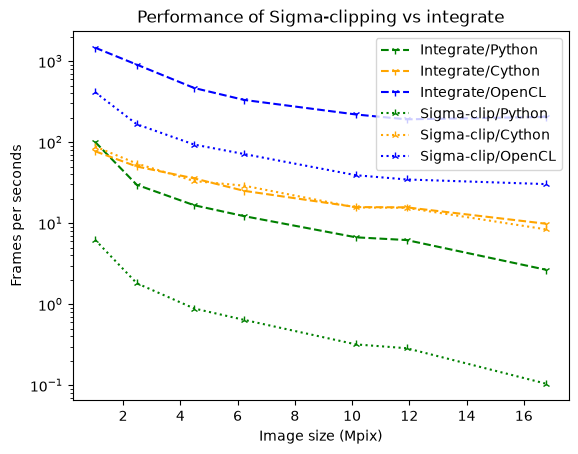
The penalty is very limited in Cython, much more in Python.
The biggest limitation of sigma-clipping is its incompatibility with pixel-splitting, a feature needed when oversampling, i.e. taking many more points than the size of the diagonal of the image. While oversampling is not recommended in the general case (due to the cross-correlation between bins it creates), it can be a necessary evil, especially when performing Rietveld refinement where 5 points per peak are needed, resolution that cannot be obtained with the pixel-size/distance couple accessible by the experimental setup.
Median filter in Azimuthal space#
The idea is to sort all pixels contributing to an azimuthal bin and to average out all pixels between the lower and upper quantile. When those two thresholds are at one half, this filter provides actually the median. In order to be compatible with pixel splitting, each pixel is duplicated as many times as it contributes to different bins. After sorting fragments of pixels according to their normalization corrected signal, the cumulative sum of normalization is performed in order to determine which fragments to average out.
ai = pyFAI.load(UtilsTest.getimage("Pilatus6M.poni"))
img = fabio.open(UtilsTest.getimage("Pilatus6M.cbf")).data

method = ["full", "csr", "cython"]
percentile=(40,60)
pol=0.99
fig, ax = subplots(1, 2, figsize=figsize)
jupyter.display(img, ax=ax[1])
jupyter.plot1d(ai.medfilt1d_ng(img, 1000, method=method, percentile=percentile, polarization_factor=pol), ax=ax[0])
ax[1].set_title("With a few Bragg peaks")
ax[0].set_title("Median filtering");
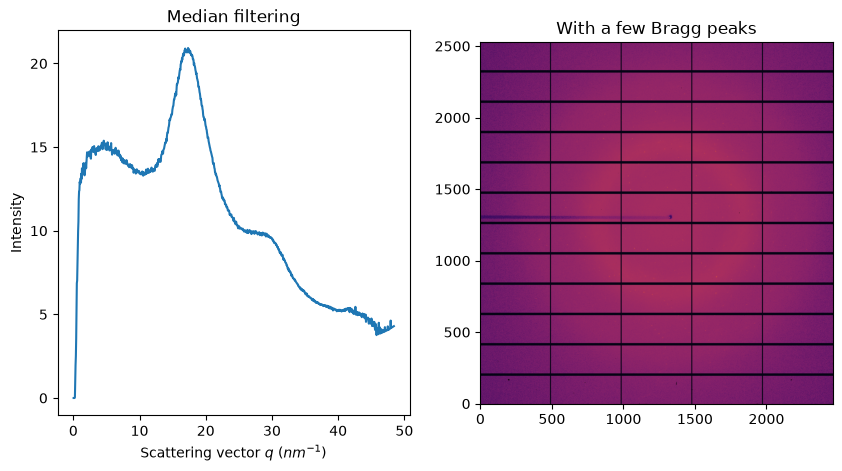
Unlike the sigma-clipping, this median filter does not require any error model; but the computational cost induced by the sort is huge. In addition, the median is very sensitive and requires a good geometry and modelisation of the polarization.
%%time
perf2_integrate_python = {}
perf2_integrate_cython = {}
perf2_integrate_opencl = {}
perf2_medfilt_python = {}
perf2_medfilt_cython = {}
perf2_medfilt_opencl = {}

for ds in pyFAI.benchmark.PONIS:
    ai = pyFAI.load(UtilsTest.getimage(ds))
    if ai.wavelength is None: ai.wavelength=1.54e-10
    img = fabio.open(UtilsTest.getimage(pyFAI.benchmark.datasets[ds])).data
    size = numpy.prod(ai.detector.shape)
    print(ds)
    print("     Cython")
    meth = tuple(method)
    nbin = max(ai.detector.shape)
    print("     * integrate   ", end="")
    perf2_integrate_cython[size] = %timeit -o ai.integrate1d(img, nbin, method=meth)
    print("     * medianfilter", end="")
    perf2_medfilt_cython[size] = %timeit -o ai.medfilt1d_ng(img, nbin, method=meth)
    print("     Python")
    meth = tuple(method[:2]+["python"])
    print("     * integrate   ", end="")
    perf2_integrate_python[size] = %timeit -o ai.integrate1d(img, nbin, method=meth)
    print("     * medianfilter", end="")
    perf2_medfilt_python[size] = %timeit -o ai.medfilt1d_ng(img, nbin, method=meth)

    print("     OpenCL")
    meth = tuple(method[:2]+["opencl"])
    print("     * integrate   ", end="")
    perf2_integrate_opencl[size] = %timeit -o ai.integrate1d(img, nbin, method=meth)
    print("     * medianfilter", end="")
    perf2_medfilt_opencl[size] = %timeit -o ai.medfilt1d_ng(img, nbin, method=meth)
Pilatus1M.poni
     Cython
     * integrate
19.5 ms ± 3.22 ms per loop (mean ± std. dev. of 7 runs, 1 loop each)
     * medianfilter
19.4 ms ± 2.18 ms per loop (mean ± std. dev. of 7 runs, 10 loops each)
Compiler time: 0.20 s
     Python
     * integrate
12.8 ms ± 37.6 μs per loop (mean ± std. dev. of 7 runs, 100 loops each)
     * medianfilter
1.28 s ± 7.59 ms per loop (mean ± std. dev. of 7 runs, 1 loop each)
     OpenCL
     * integrate
727 μs ± 1.22 μs per loop (mean ± std. dev. of 7 runs, 1,000 loops each)
     * medianfilter
9.4 ms ± 9.17 μs per loop (mean ± std. dev. of 7 runs, 100 loops each)
Pilatus2M.poni
     Cython
     * integrate
25.7 ms ± 6.03 ms per loop (mean ± std. dev. of 7 runs, 1 loop each)
     * medianfilter
69.5 ms ± 3.47 ms per loop (mean ± std. dev. of 7 runs, 10 loops each)
     Python
     * integrate
45.5 ms ± 248 μs per loop (mean ± std. dev. of 7 runs, 10 loops each)
     * medianfilter
4.39 s ± 49.9 ms per loop (mean ± std. dev. of 7 runs, 1 loop each)
     OpenCL
     * integrate
1.25 ms ± 2.44 μs per loop (mean ± std. dev. of 7 runs, 1,000 loops each)
     * medianfilter
30.8 ms ± 21.7 μs per loop (mean ± std. dev. of 7 runs, 10 loops each)
Eiger4M.poni
     Cython
     * integrate
37.1 ms ± 3.61 ms per loop (mean ± std. dev. of 7 runs, 1 loop each)
     * medianfilter
113 ms ± 633 μs per loop (mean ± std. dev. of 7 runs, 10 loops each)
     Python
     * integrate
81.5 ms ± 88.9 μs per loop (mean ± std. dev. of 7 runs, 10 loops each)
     * medianfilter
7.41 s ± 72.5 ms per loop (mean ± std. dev. of 7 runs, 1 loop each)
     OpenCL
     * integrate
2.34 ms ± 2.75 μs per loop (mean ± std. dev. of 7 runs, 100 loops each)
     * medianfilter
54.3 ms ± 25.8 μs per loop (mean ± std. dev. of 7 runs, 10 loops each)
Pilatus6M.poni
     Cython
     * integrate
46.9 ms ± 3.39 ms per loop (mean ± std. dev. of 7 runs, 1 loop each)
     * medianfilter
154 ms ± 4.57 ms per loop (mean ± std. dev. of 7 runs, 10 loops each)
     Python
     * integrate
111 ms ± 247 μs per loop (mean ± std. dev. of 7 runs, 10 loops each)
     * medianfilter
10.9 s ± 71.4 ms per loop (mean ± std. dev. of 7 runs, 1 loop each)
     OpenCL
     * integrate
3.29 ms ± 3.13 μs per loop (mean ± std. dev. of 7 runs, 100 loops each)
     * medianfilter
78 ms ± 75.5 μs per loop (mean ± std. dev. of 7 runs, 10 loops each)
Eiger9M.poni
     Cython
     * integrate
65.2 ms ± 2.77 ms per loop (mean ± std. dev. of 7 runs, 1 loop each)
     * medianfilter
306 ms ± 7.75 ms per loop (mean ± std. dev. of 7 runs, 1 loop each)
     Python
     * integrate
190 ms ± 3.64 ms per loop (mean ± std. dev. of 7 runs, 1 loop each)
     * medianfilter
18.4 s ± 35.8 ms per loop (mean ± std. dev. of 7 runs, 1 loop each)
     OpenCL
     * integrate
5.66 ms ± 1.39 ms per loop (mean ± std. dev. of 7 runs, 1 loop each)
     * medianfilter
139 ms ± 126 μs per loop (mean ± std. dev. of 7 runs, 10 loops each)
Mar3450.poni
     Cython
     * integrate
75.4 ms ± 5.09 ms per loop (mean ± std. dev. of 7 runs, 1 loop each)
     * medianfilter
257 ms ± 2.29 ms per loop (mean ± std. dev. of 7 runs, 1 loop each)
     Python
     * integrate
221 ms ± 849 μs per loop (mean ± std. dev. of 7 runs, 1 loop each)
     * medianfilter
21.4 s ± 183 ms per loop (mean ± std. dev. of 7 runs, 1 loop each)
     OpenCL
     * integrate
5.94 ms ± 22.2 μs per loop (mean ± std. dev. of 7 runs, 1 loop each)
     * medianfilter
162 ms ± 191 μs per loop (mean ± std. dev. of 7 runs, 10 loops each)
Fairchild.poni
     Cython
     * integrate
109 ms ± 3.46 ms per loop (mean ± std. dev. of 7 runs, 1 loop each)
     * medianfilter
401 ms ± 15.1 ms per loop (mean ± std. dev. of 7 runs, 1 loop each)
     Python
     * integrate
306 ms ± 429 μs per loop (mean ± std. dev. of 7 runs, 1 loop each)
     * medianfilter
25.6 s ± 184 ms per loop (mean ± std. dev. of 7 runs, 1 loop each)
     OpenCL
     * integrate
5.32 ms ± 34.2 μs per loop (mean ± std. dev. of 7 runs, 1 loop each)
     * medianfilter
173 ms ± 107 μs per loop (mean ± std. dev. of 7 runs, 10 loops each)
CPU times: user 25min 59s, sys: 31.9 s, total: 26min 31s
Wall time: 14min 50s
fig, ax = subplots()
ax.set_xlabel("Image size (Mpix)")
ax.set_ylabel("Frames per seconds")
sizes = numpy.array(list(perf2_integrate_python.keys()))/1e6
ax.plot(sizes, [1/i.best for i in perf2_integrate_python.values()], label="Integrate/Python", color='green', linestyle='dashed', marker='1')
ax.plot(sizes, [1/i.best for i in perf2_integrate_cython.values()], label="Integrate/Cython", color='orange', linestyle='dashed', marker='1')
ax.plot(sizes, [1/i.best for i in perf2_integrate_opencl.values()], label="Integrate/OpenCL", color='blue', linestyle='dashed', marker='1')
ax.plot(sizes, [1/i.best for i in perf2_medfilt_python.values()], label="Medfilt/Python", color='green', linestyle='dotted', marker='2')
ax.plot(sizes, [1/i.best for i in perf2_medfilt_cython.values()], label="Medfilt/Cython", color='orange', linestyle='dotted', marker='2')
ax.plot(sizes, [1/i.best for i in perf2_medfilt_opencl.values()], label="Medfilt/OpenCL", color='blue', linestyle='dotted', marker='2')
ax.set_yscale("log")
ax.legend()
ax.set_title("Performance of Median filtering vs integrate");
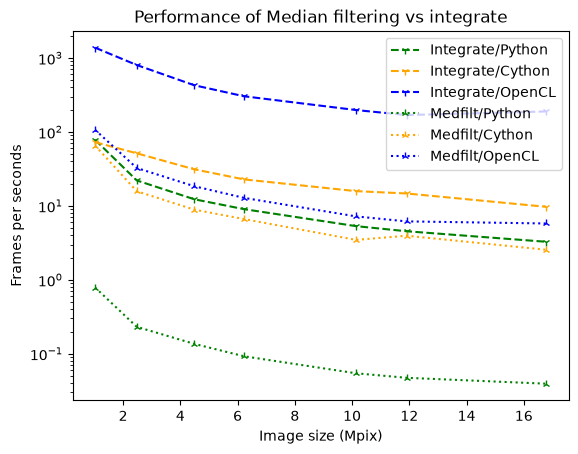
As one can see, the penalties are much larger for OpenCL and Python than for Cython.
Conclusion#
Sigma-clipping and median-filtering are alternatives to azimuthal integration and offer the ability to reject outliers. They are not more difficult to use but slightly slower owing to their greater complexity.